Bulletin:   At a meeting on Feb 13, 2008, with permitting authorities, CE Williams inadvertently displayed a slide showing that PGCD had seeded in Briscoe and Swisher Counties.    When he was asked by a local rancher if he had a permit to seed in those counties, he indignantly said he had.   Fortunately, a Briscoe County rancher had the permit with him and confronted him with his misrepresentation.  

    The Texas Department of licensing regulations plainly state (b) The Department may refuse to renew the license of any applicant who:  (1) has failed to comply with any provision of the license, the Act, this chapter, or any Texas weather modification permit issued to the licensee by the Department; we will see if the process works and whether now that there is proof positive of the mendacity ranchers have been reporting for years, they will deny this rainmaker their permit.

    At the hearing, every farmer and rancher who spoke, spoke against the seeding.    Everyone wonders how the PGCD board can put up with the lack of truthfulness of their exec and with his willing violation of the permit.   How can the board disregard the agricultural producers?

Cloud Seeding Found to be Snake Oil

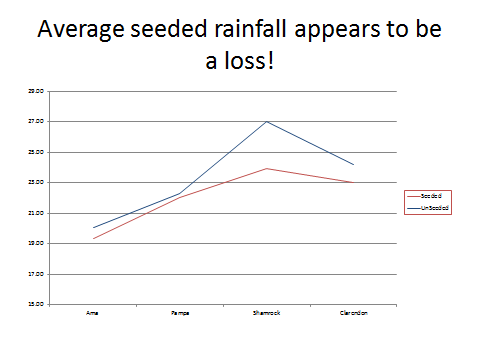
    Texas groundwater districts are seeding clouds with the hope of increasing rain.   Panhandle Groundwater Conservation District claims to have added 38/100" of rain during the last year.   As with most bureaucracies, the state and the groundwater districts are now fighting to sustain their tax dollars.   Recent meetings have shown that scientists who are not earning their living from cloud seeding question the data being presented by the Texas districts.   Groundwater District meteorologists from Cuba and Europe are claiming that rainfall does not diminish the amount of moisture in clouds and that The American Meteorological Society and the World Meteorological Society are out of date.

    The meeting in the High Plains Groundwater District presented good data on cloud seeding and the District responded to science by stopping seeding.   See information from that meeting.    The North Plains District has also ceased seeding in response to agricultural producers.

    Owners of over 75% of the land mass in Potter County and over 50% in Donley and Armstrong Counties have signed petitions to stop seeding, but the Panhandle Groundwater District refuses to listen to the landowners.

    In an effort to convince land owners that seeding pays, The Panhandle Groundwater District has put out promotional literature and held meetings in the district.   In Amarillo, not one landowner supported the effort.  

    The data in the Economic Precipitation Impact is fallacious.    It claims that an inch of rain per acre is worth $4.75 per acre.   This is more than the acre cost of many grass leases for a year.    They say that the value of an acre inch of rain on peanuts is $27.20 per acre; per acre of cotton, an inch of rain is worth $18.90 per acre.   A Donley County Peanut producer and rancher asked, "What kind of stuff are they smoking?   We don't want people with no more concern than that for economics to be trying to effect our weather.   I knew their rainfall figures were bogus, but I can't believe any of this.   This is not even close enough for government work."

    At a December 4, 2002 meeting in Amarillo sponsored by the Panhandle Groundwater District and the North Plains Groundwater District, seeding experts, Cuban scientists and Dale L. Bates, head of the Texas Weather Modification Association  claimed that Silver Iodide is not toxic.   


Rancher Johnny Micou said, "During the meeting, one person said that silver was good for the heart. In a private conversation, I was told silver miners live longer. Although cloud seeding uses relatively small amounts of silver iodide, it begs the question of repeated use over a long period of time, how much accumulation would occur and the subsequent health risks."  He sent them the following web sites:

 http://www.nature.nps.gov/hazardssafety/toxic//silver.pdf

 http://www.silvermedicine.org/whosilvercompoundtoxicity.html &

 http://www.ehs.berkeley.edu/pubs/guidelines/draindispgls.html with concern that they had such lack of respect for the chemicals they were using.   "Cooper and Jolly (1970) in a review of the ecologic effects of silver have pointed out that the current experimental practice of seeding clouds with silver iodide to promote rainfall may lead to new hazards for both man and natural biologic systems if the practice is extended (Petering, 1976),"  puts it in a nutshell.  Read Johnny's report.


In addition, "Fallout from cloud seeding with silver iodide is not always confined to local precipitation; silver residuals have been detected several hundred kilometers downwind of seeding events."


Panhandle Groundwater Conservation District members have started attacking the personal integrity of critics of their plan.   When it is brought up that their rainfall data was found false, they imply that the person pointing it out had something to do with the bad data.   If they would look at scientific data, they would not have to make personal attacks.


Dr. William R. Cotton, a professor of atmospheric science at Colorado State University in Fort Collins, has posted a site on cloud seeding.   He states, "We have seen that with few exceptions, the scientific evidence is not conclusive cloud seeding is causing the desired responses. More over, the evidence that human activity is 'causing' observed changes in weather and climate is also quite tenuous."   He also addresses over selling.


Dr. Cotton concludes, "Loss of scientific credibility is infectious and can, therefore, propagate through an entire scientific discipline and even to the scientific community as a whole. The fall of the science of weather modification by cloud seeding was almost certainly due, in part, to a loss of scientific credibility. The global climate change community must likewise be careful that a loss of scientific credibility does not propagate through their discipline, or the discipline of atmospheric science as well. Thus premature advocacy that action be taken now, could, in the long run, destroy the prospects for obtaining solid scientific evidence that human activity is affecting weather and climate."


Dr. Chuck Doswell is a nationally acclaimed meteorologist who was with the National Severe Storms Laboratory in Norman, Oklahoma, has published an insightful essay on weather modification debunking the pseudo science of PGCD at http://www.flame.org/~cdoswell/wxmod/wxmod.html


Al Rangno, research meteorologist at the University of Washington, wrote, "Continuing the "unscientific" cloud seeding, the type that is now being done in Texas — where practitioners seed as many clouds of their choosing as possible merely in hopes that more rain is being produced — constitutes a dead end. Fifty years from now we could still be having the same debate about whether cloud seeding has increased rainfall."   He speaks of bad science and the need for a randomized experiment, saying we need to "end the cycle of inadequately supported claims of cloud seeding successes, claims today that are not dissimilar to the ones that Texas A&M Distinguished Professor of Meteorology Horace R. Byers described almost 40 years ago as '...based on evidence so questionable as to seem farcical to a sophisticated statistician.'"

There is ample information to stop the project.   Please follow the following links:

Scientific paper on weather modification.

see research by Billy Tiller.

see further statements by ranchers

results of meeting on cloud seeding

Is Cloud Seeding Harmful?

Expert editorial on scientific validity of experiments.

Click on brand to link to another ranch's information.